Introducing MiMo-V2.6 series
Frontier intelligence, all the modalities, built in public.
Today, we are releasing and open-sourcing the MiMo-V2.6 series. This marks a key step in our exploration of the RSI path: scaling RL compute on verifiable, complex tasks, so the model can continuously expand its capability frontier through exploration and feedback.
The MiMo-V2.6 series includes two natively omnimodal models: MiMo-V2.6-Pro is our most capable model to date, while MiMo-V2.6-Flash strikes the best balance between intelligence, efficiency, and cost. We are also rolling-out MiMo-V2.6-Pro-UltraSpeed, delivering up to 20x faster output speed at the same quality, for users who require extreme generation speed.
Pushing the Pareto Frontier
MiMo-V2.6-Pro scores 46.32 on the Artificial Analysis Intelligence Index, surpassing Kimi K3 and Qwen3.8 Max to become the strongest open-source model to date. The MiMo-V2.6 series keeps the API pricing of the V2.5 series. Higher intelligence at the same price pushes the Pareto frontier of intelligence versus cost outward once again.
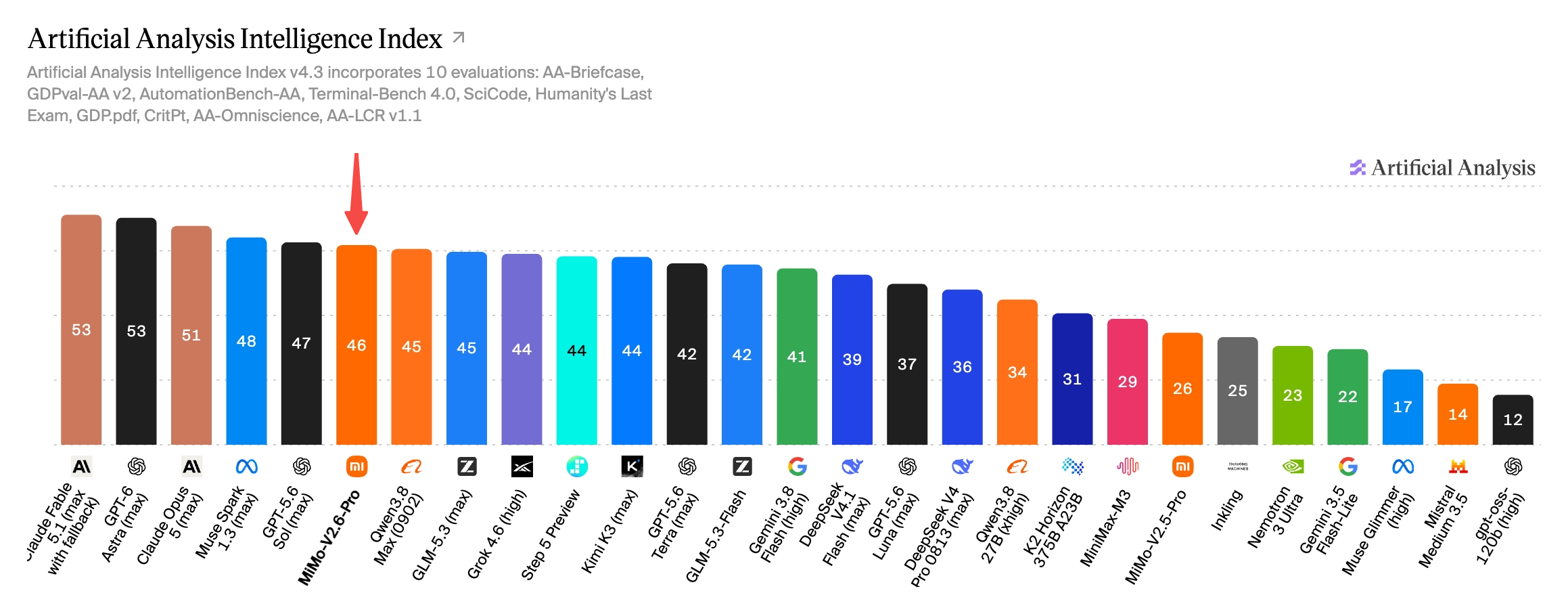
Artificial Analysis Intelligence Index v4.3, September 2026. MiMo-V2.6-Pro is the highest-scoring open-source model.
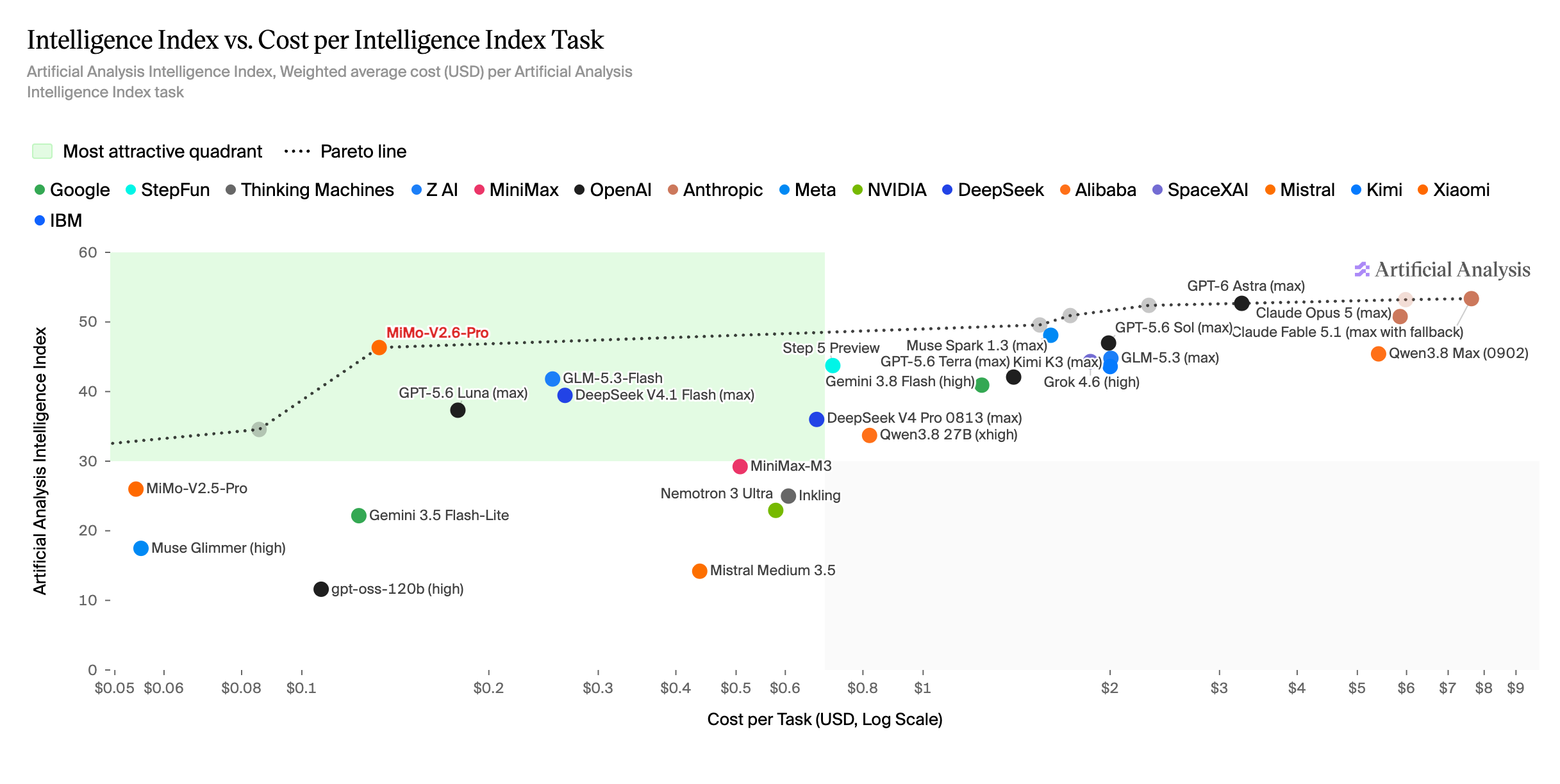
Intelligence Index against cost per Intelligence Index task (log scale). MiMo-V2.6-Pro sits on the Pareto line, inside the most attractive quadrant. Source: Artificial Analysis.
Scaling RL, Fully Open-Sourced
Along the way we worked through the research and engineering problems of RL training, and we streamed the production run live as it happened. In under six days, MiMo-V2.6-Flash and MiMo-V2.6-Pro each completed 30 RL steps over roughly 750k trajectories, at a cost of about $0.85M and $2.62M respectively. Average pass rate on the training tasks rose by 25% and 12% in relative terms. On DeepSWE v1.1, a held-out long-horizon software engineering benchmark, scores rose by about 17 points (from 48.8 to 65.68) and about 14 points (from 58.4 to 72.57). RL proved sample-efficient, kept improving throughout the run, and generalized beyond the training distribution.
RL training progress over 30 steps on DeepSWE v1.1 (coding), AutomationBench v1.0.6 (general workflows) and MiMo Visual Coding (visual tasks). Upper curves: benchmark score. Lower band: total tokens, in thousands. Hover for the values at any step.
We scaled RL compute along three axes:
- Larger batches and higher throughput: large batches on a fully asynchronous architecture, with 1,568 samples per update, training at up to 1M context length, and 3.5 to 3.7B tokens per step.
- More tasks and richer environments: a multi-task training suite spanning coding, general agents, visual and cyber, mixed across several harnesses so that gains in one capability reinforce the others.
- More grader compute: relative comparison within each group gives long-horizon RL tasks more precise and more diverse reward signals, closes a self-improvement loop, and steers the model toward shorter paths and fewer tokens per task.
As the run scaled up, we froze the router to suppress training drift, and built a defense against reward hacking spanning reward design, adversarial evaluation, anomaly detection and cross-checking between verifiers, improving both training stability and reward reliability.
To support agentic reinforcement learning at scale across heterogeneous tasks, we designed a unified trajectory representation and penalty mechanism to provide finer-grained learning signals, enabled high-concurrency interaction across multiple agent frameworks, decoupled the control plane from the data plane to support large-scale trajectory migration, stabilized per-task sampling ratios within mixed batches, and optimized both the training and inference engines as well as their consistency.
We are open-sourcing all of the above along with the resources around it: the full technical report, the training environments and the RL code, so that researchers can reproduce and verify these results and join us in exploring what scaled RL and model self-improvement can do next.
From Vibe Coding to Vibe World
MiMo’s coding ability has generalized well beyond software engineering. Given a goal, a harness and time, it takes on real productive work. It builds, tests and ships, and keeps producing economic value. MiMo-V2.6 brings together 3D spatial reasoning, multimodal perception, and computer-use agent (CUA) capabilities, further expanding the boundaries of what coding can reach. It extends natural-language-driven programming from building software to building interactive worlds — what we call “Vibe World.”
Game Development
Given an image, video, or text prompt, MiMo-V2.6 decomposes the request into multiple tasks and coordinates multiple agents to build 3D scenes, implement interaction logic, and perform visual verification. It then iteratively refines the result based on rendered outputs, ultimately producing a runnable interactive world aligned with the user’s intent.
3D Modeling
MiMo-V2.6 can generate 3D objects and scenes in Blender from a user’s text description or reference image, producing 3D assets for animation, 3D printing, and game development.
Embodied Simulation
In embodied simulation environments, MiMo-V2.6 can directly take multi-view camera feeds as input, continuously reason and make decisions, and control a Franka Panda robotic arm in a closed loop through visual feedback to perform object grasping, color matching, and precise placement.
Visual & Design
MiMo-V2.6 turns a simple instruction into a complete frontend interface or slide deck, with a structured layout, carefully designed components, interactive elements and rich animation. It is also fluent with Figma and with image and video generation tools, producing visual assets that fit the overall style, and it keeps typography, color and the arrangement of text and images coherent, balancing aesthetic quality with the reading and interaction experience.
Frontend Design
MiMo has its own taste.
Presentation Design
Three decks, each from a one-line brief: an internal engineering training on how an LLM learns, a research note on the critical minerals supercycle, and a design review proposing three directions for a company’s first annual report.
Video Clip
Motion is the natural extension of a static design. MiMo-V2.6 can deliver high-quality video creation end to end. For creative and product promo videos, it can handle visual design, shot and motion sequencing, music composition, and beat-synced editing based on user requirements. For educational videos, it can turn abstract concepts such as Fourier decomposition into accessible explanations and coherent animations, and use MiMo-V2.5-TTS to generate narration precisely aligned with the visuals. This enables full-process automation from concept breakdown to final video output, transforming complex knowledge into vivid content that is easy for audiences to understand.
Music Composition
MiMo-V2.6 also strengthens the model’s understanding of music, its aesthetic judgment and its use of musical knowledge, as a first exploration of composition. It can already write demo-quality pieces, and it shows potential as an assistant to professional composers and arrangers.
In this case, MiMo-V2.6-Pro was asked to compose an orchestral piece for about ten instruments. It wrote the score and then converted it to MIDI on its own. The result shows an understanding of how the instruments divide the work and relate to one another in the orchestration, and of how to apply musical knowledge to melody and to the arrangement as a whole.
The orchestral piece, Night Road, played back in a DAW from the MIDI MiMo-V2.6-Pro produced: strings, oboe, clarinet, trumpet, trombone, French horn, glockenspiel and timpani.
In a second case we asked MiMo-V2.6 for two piano pieces in A minor, one slow and one at a moderate tempo. They show the model’s command of dynamics, texture and the other elements that make up a composition.
Research
Even without reinforcement learning specifically tailored to scientific research, MiMo-V2.6 has already shown promise across multiple research fields. From materials design to mathematical formalization, the following case studies illustrate how the model applies its reasoning, coding, and tool-use capabilities to concrete research tasks.
Co-scientist for Materials Research
MiMo-V2.6-Pro can serve as a co-pilot for human scientists. Over several rounds of prompting, Xiaomi’s materials experts tasked MiMo-V2.6-Pro with designing an entirely new metal-organic framework (MOF) material capable of adsorbing per- and polyfluoroalkyl substances (PFASs), a class of “forever chemicals.” MiMo-V2.6-Pro successfully conducted a comprehensive web search, reviewed the relevant literature and patents, proposed hypotheses, assessed novelty, and then moved on to “dry experiments”: calling open-source computational tools, automatically setting up the simulation environment, calculating the binding strengths between MOF materials and PFASs, and identifying promising candidates for the “wet-lab” stage. Read the full case study.
Three candidate UiO-67-type Zr₆ frameworks proposed and screened in silico by MiMo-V2.6-Pro, differing in the pore-wall ligand. The perfluorooctanoate guest is drawn in vermilion; hydrogens are hidden. Geometries from the model’s own optimization runs.
Formalizing Mathematical Proofs
MiMo-V2.6-Pro assisted researchers in completing a Lean 4 formalization of the full main theorem in Li and Yorke’s classic paper, Period Three Implies Chaos. The theorem establishes that, for a continuous self-map of an interval, the existence of a period-three orbit implies periodic orbits of every positive integer period, as well as an uncountable scrambled set.
Guided by an exploration strategy designed by the researchers, MiMo-V2.6-Pro used subagent collaboration to advance the formalization of both the theorem statement and its proof. Following further revision and integration, the project comprised more than 6,000 lines of Lean source code. The complete proof was verified by Lean’s kernel, with no unfinished proof placeholders. The model had received no Lean-specific post-training, making this case a demonstration of its ability to contribute to complex formalization tasks. The full Lean code can be downloaded here.
Bifurcation diagram of the logistic map: as the parameter increases, period-doubling bifurcations lead to chaos, interspersed with periodic windows such as period three. The Li-Yorke theorem states that, for a continuous self-map of an interval, a period-three orbit guarantees periodic orbits of every positive integer period and an uncountable scrambled set.
Availability
MiMo-V2.6-Pro and MiMo-V2.6-Flash are available today in AI Studio, MiMo Code and MiMo Desktop, through the MiMo API Platform, and on OpenRouter.
MiMo Desktop
Alongside MiMo-V2.6, MiMo Desktop leaves early access and ships its first official release, with MiMo-V2.6-Pro and MiMo-V2.6-Flash built in. Download it here. MiMo Desktop also launches MiMo-V2.6-Pro-UltraSpeed, an ultra-fast mode that runs at up to 20x the speed of MiMo-V2.6-Pro, for real-time interaction and any workflow that is sensitive to response time. The early-access program runs for one more week; if you already have access, switch to the new model names to keep using it.
API
MiMo-V2.6 is live on the Xiaomi MiMo Open Platform, with API pricing unchanged from V2.5. MiMo-V2.6-Pro can also be called in UltraSpeed mode, at up to 20x the output speed. A Token Plan is available for predictable, high-volume usage.
| Model | Input (cache hit) | Input (cache miss) | Output |
|---|---|---|---|
| MiMo-V2.6-Flash | $0.0028 | $0.14 | $0.28 |
| MiMo-V2.6-Pro | $0.0036 | $0.435 | $0.87 |
| MiMo-V2.6-Pro-UltraSpeed | $0.036 | $4.35 | $8.7 |
USD per million tokens. Cache writes are free for a limited time. RMB pricing for China is listed on the pricing page.
Appendix: Full Benchmark Results
Scores for the full comparison set, including the benchmarks not shown in the overview above.
Higher is better. GDPVal 2.1 is an Elo rating reported by Artificial Analysis. Bold marks the best score on each benchmark; a dash means no result.