How Xiaomi MiMo-V2.6-Pro Boosts Productivity in New Materials R&D
From literature review to molecular design and automated dry-lab experiments.
A co-scientist for materials R&D
Estimated gain in productivity
Team estimate for this materials design workflow, including computational dry-lab experiments. Candidate materials await wet-lab validation.
Large language models are transformative in fields ranging from software development and mathematics to law and financial auditing. A recent trend is to bring those productivity gains to scientific research and development.
Xiaomi’s Materials Core team explored that potential with MiMo-V2.6-Pro. Could it carry out an end-to-end materials design workflow, from reviewing literature and patents to proposing novel ideas and running automated computational simulations? These “dry-lab experiments” could help researchers identify more promising candidates for resource-intensive wet-lab testing.
We chose water quality as a practical test case: could MiMo-V2.6-Pro help design a new material to capture hazardous PFAS from water?
What Are PFAS?
PFAS, short for 'per- and polyfluoroalkyl substances,' are a group of chemicals known for their persistence. Many break down very slowly in natural environment, and some can accumulate in living organisms. Exposure to certain PFAS has been linked to adverse effects on immune function, liver health, and development, as well as an increased risk of some cancers. These concerns have prompted regulations worldwide. The European Union has already banned or restricted the use of substances such as perfluorooctanesulfonic acid (PFOS) and perfluorooctanoic acid (PFOA) and is pursuing broader restrictions on PFAS through its REACH framework.
PFAS are used in a wide range of everyday products, including food packaging, outdoor clothing, nonstick cookware, adhesive tapes, and electronics. Their resistance to water, grease, and stains makes them useful, but their persistence and potential health effects have attracted growing scrutiny from regulators and consumers. Companies are also increasingly promoting efforts to reduce or eliminate PFAS as a selling point.
PFAS can spread through the water cycle and contaminate drinking water. A previous report2 detected PFAS in 99% of the bottled water samples tested and claimed that treatments such as filtration and adsorption could reduce PFAS concentration by 50–90%. Developing effective adsorbents is therefore an important part of efforts to reduce PFAS contamination in drinking water.
PFOA, a typical PFAS as illustrated below, shows how these molecules can interact with an adsorbent. In water, its carboxyl group typically loses a proton, forming a negatively charged carboxylate “head” attached to a fluorinated “tail.” A well-designed adsorbent can bind the head while accommodating the tail within its pores, helping to hold the molecule in place.

Using a “Nobel Prize Material” for Selective and Effective PFAS Capture
For this demonstration, we chose metal–organic frameworks (MOFs), a class of porous materials whose development was recognized with the 2025 Nobel Prize in Chemistry.3
Think of a MOF as a molecular scaffold with tiny cavities and channels. Metal nodes are connected by organic molecules called linkers, which help determine the size, shape, and surface chemistry of the pores. By modifying these linkers, researchers can tailor the material to attract and bind specific pollutants. Compared with conventional adsorbents such as activated carbon, MOFs offer greater flexibility to design these interactions at the molecular level, making them promising candidates for selective PFAS capture.
That design flexibility also presents a challenge: finding the right combination of building blocks, pore structure, and surface chemistry. Even experienced researchers may need many rounds of design, testing, and refinement—with possible setbacks along the way—before identifying a promising approach.
How MiMo-V2.6-Pro Serves as a Co-scientist
MiMo-V2.6-Pro helped our materials experts streamline this process. Through several rounds of expert guidance and prompting, the team used the model to develop new MOF designs for PFAS capture. The model reviewed scientific literature and patents, proposed design hypotheses, and checked its proposals for novelty. It then carried out computational “dry-lab experiments,” automatically setting up the simulation environment, running open-source tools, and calculating how strongly PFAS would bind to each design to identify promising candidates.
From a research question to candidate materials
- 01Literature & patentsReview existing research
- 02Design hypothesesPropose and check novelty
- 03Dry-lab experimentsBuild and run simulations
- 04Candidate materialsPrioritize for wet-lab testing
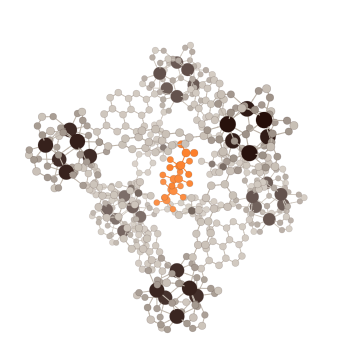
To strengthen PFAS binding, the model introduced positively charged groups onto the MOF’s internal surfaces to attract the molecules’ negatively charged heads. It also incorporated larger, flatter aromatic groups to accommodate PFAS fluorinated tails. These modifications produced the A50 and B50 designs shown below.
The resulting designs combine three features: positively charged binding sites, tailored pore structures, and hydrophobic aromatic ligands. Together, these features are intended to capture PFAS and hold the molecules securely within the pores. In the simulations, A50 and B50 showed PFAS adsorption performance one million to ten million times that of the reference material, C50.
Molecular structures generated by MiMo-V2.6-Pro
Overall we estimate that MiMo-V2.6-Pro improved human experts' work efficiency tenfold, shortening the R&D cycle from one month to 2–3 days. The structures of the resulting MOF candidates A50 and B50, together with the baseline control material C50, are shown below:
Original computational structures
Select an image to enlarge ↗Perspectives from materials researchers
We also invited third-party experts to evaluate the materials research workflow demonstrated by MiMo-V2.6-Pro and the new MOF materials it proposed:
I was impressed by MiMo’s computational design work on MOFs for PFAS capture. The scientific literature is growing so rapidly that even experienced specialists struggle to keep up with developments in their own fields. MiMo can quickly synthesize existing research, develop new MOF designs tailored to materials experts’ requirements, and independently run simulations to provide theoretical support for those designs. In my view, its work on this project—from literature review to materials design and computational evaluation—was on par with that of a well-trained doctoral researcher. These candidates deserve further experimental investigation, and I look forward to seeing MiMo contribute valuable ideas to other areas of materials research.
That morning, I had just read news about the live stream of Xiaomi MiMo-V2.6-Pro’s public training; by that evening, I learned that an internal preview version had already completed a computational MOF design project under expert guidance. I was astonished. The challenge goes beyond running simulation software: it involves turning design concepts into chemically sound structural models. Determining how metals and ligands connect, and whether the coordination geometry and three-dimensional arrangement make sense, requires both chemical knowledge and spatial reasoning. MiMo-V2.6-Pro brought together literature review, structural design, and computational evaluation, showing its potential to move from offering suggestions to actively contributing to research. This is an encouraging step toward making large language models productive tools for science, and I am eager to see these designs tested experimentally.
References
- European Chemicals Agency. Per- and polyfluoroalkyl substances (PFAS).
- Gao, C., Drage, D. S., Abdallah, M. A.-E., Quan, F., Zhang, K., Hu, S., Zhao, X., Zheng, Y., Harrad, S., & Qiu, W. (2024). Factors influencing concentrations of PFAS in drinking water: Implications for human exposure. ACS ES&T Water. doi:10.1021/acsestwater.4c00533 ↗
- The Nobel Prize in Chemistry 2025 — Press release.